
We all know that feeling when we find it difficult to move away from a difficult situation or relationship. That feeling of ‘stuckness’ where we feel trapped, sometimes long after we have physically left a situation. We know deep down that we should break away, but why does it feel so hard?
It turns out, that feeling of being stuck, trapped or unable to move on is actually our body’s warning system letting us know that moving on might be emotionally unsafe.
I’ve been doing some work around trauma and in doing so I was looking at resources produced by the brilliant Carolyn Spring, who is somewhat of an authority when thinking about trauma.
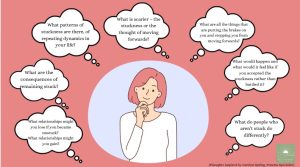
I came across a resource about Stuckness. It’s called A Stuckness Checklist: Some Questions to Consider. On it is a series of questions that we can ask ourselves about how it serves us to stay in a situation that is causing upset or remain caught up in an event that might have happened several months or even years ago. People may tell us to ‘get over it’ or tell us that we are becoming obsessed. ‘You need to move on,’ they say, but for those ‘stuck’ it can seem impossible.
In extreme cases, it can feel debilitating. Remaining stuck in a situation or thought process that is damaging stops us from moving on to a place that is going to make us happier but unfortunately, moving on is hard.
Often it means accepting the situation as it is. And accepting that a relationship is over or that a person is no longer with us or that we really should move out of the family home or leave that job or put the dog to sleep is a lot harder than just staying in the moment.
It means accepting that what once was is no longer. It means that accepting what could have been is no longer possible. It might mean accepting that someone doesn’t love us, or even that they never did. It could also mean accepting that you were wrong about something, and that can be the hardest kind of acceptance of them all.
It can be difficult to accept that a situation is not going to change because you have no control over other people in your life. So often, when a client comes to me and asks how to deal with a situation, we explore what is in the client’s control and what is not. The thoughts, actions and reactions of another person is not within the client’s control. We can only control how we act and react and when we accept that, we take the first step to becoming unstuck.
So what are the benefits of remaining stuck?
There is multi-step process involved in becoming unstuck and moving on and unfortunately, we can slide backwards and forwards along that imaginary scale.
For example, imagine you’re in a relationship that makes you happy. The other person ends that relationship because it is no longer right for them. You want to be in that relationship. You can’t see any reason why that relationship doesn’t work, because it makes you happy. The other person disagrees and leaves anyway.
You are devastated. You are no longer happy. You want to be happy and you were happy in that situation so the only way you can see to be happy is to be back in that relationship. You try again to convince the other party that the relationship works because it makes you happy.
They leave anyway and you go back to being unhappy.
And that’s where you stay. Unhappy.
It can be hard to detach. There may be unfinished business that is preventing closure. This is very often the case when an event has been sudden, but not always.
Questions left unanswered, ambiguous and unexplained endings, failure to be explicitly clear; these can all lead to confusion that makes it hard to move on. Accepting that we may never have the answers we need can help in the effort to let go and become unstuck.
So why is it frightening to become unstuck?
Well, it could mean that we have to accept the situation.
Also, it may involve action. It may involve coming out of our comfort zone (however uncomfortable that place may be).
Imagine being in a job that you hate. Your colleagues are rude, your boss is toxic and you’ve been passed over for promotion for the last three years. You complain to your friends and family constantly and dread coming into work every day. You’re miserable.
So why don’t you leave that job and find another? Why continue to put yourself through the same upsetting experience every day?
It could be that, however unhappy you feel, there’s a safety in being there. You see familiar faces every day, you know what you’re doing and what is expected of you, you may even be over-qualified. All these things give you a sense of safety. There is no risk. You know where you are and what you are doing. Leaving the situation doesn’t seem an option.
Questions that you might reasonably ask yourself include: What if I can’t find a job? What if I don’t have the skills to go for the next step on the ladder? What if I don’t get along with my colleagues? What if the new company folds in a year and then I’m left with nothing? What if I lose my pension?
There are so many reasons not to change the situation because with action comes risk. So for a long time you think, ‘that’s too risky, I’ll just stay here.’
Some of the questions that Carolyn Spring asks are:
- What is scarier – the stuckness or the thought of moving forwards?
- What patterns of stuckness are there, of repeating dynamics in your life?
- What are all the things that are putting the brakes on you and stopping you from moving forwards?
- What would happen and what would it feel like if you accepted the stuckness rather than battled it?
- What do people who aren’t stuck do differently?
- What are the consequences of remaining stuck?
- What relationships might you lose if you became unstuck? What relationships might you gain?
It turns out, that feeling of being stuck,
trapped or unable to move on is actually our body’s warning system
letting us know that moving on might be emotionally unsafe.
Many, many clients come to counselling feeling some form of stuckness and often they report feeling powerless to do anything about it. It can feel out of our control or like it is other people who are contributing to the feeling of being trapped. When we pick it apart, we often find that when we accept that we have no control over what other people say and think, the onus is on us to unstick ourselves.
Becoming unstuck involves making really frightening decisions that effect change. We may lose people along the way and things are not predictable.
It also means accepting that the reality that we thought was true may not be the reality anymore. It can be really difficult to let go of what was and what we thought our future was going to hold.
How can counselling help?
When clients take the difficult decision to engage in counselling it’s usually because they are aware that something needs to change in order for life to be better.
When exploring why a client feels stuck and unable to make changes, a good counsellor or psychotherapist will encourage the client to:
- Explore their attachment to the status quo and how it is serving them;
- What their experience of letting go and moving on has been in the past;
- How does letting go or moving on sit with their values;
- What roles they have played in relationships;
- What their trauma response is and how it has kept them safe;
- What their experience of acting independently has been;
- How they feel about being in control, or conversely, being controlled;
- And crucially, a counsellor will help the client come to terms with the idea that things change, people change, expectations change.
All this in a calm, safe space where the client can take as much time as they need to explore how they came to be where they are and gently discover how it might feel to become unstuck.
Change, moving on and letting go is possible. Yes, it is frightening, but with a bit of time spent exploring the situation, becoming more happy and content is very much within reach.
If you would like to explore a situation that is holding you back, contact me on info@kellyworgan.co.uk